

Consider a scenario that plays out in some version in almost every renovation.
A homeowner has spent months collecting references. Countertop samples have been ordered and arranged on the kitchen floor. Cabinet door profiles have been reviewed online and in showrooms. A faucet has been bookmarked, a backsplash shortlisted, a lighting fixture approved. Each decision, made on its own terms, is sound. The countertop is durable and appropriately elegant. The cabinetry profile is clean and proportionate. The faucet is well-made and fits the intended aesthetic.
The project moves forward. Construction begins. Installation is completed.
And then something unexpected happens. The space is technically finished, all the right pieces are in place, but it does not feel the way it was supposed to. There is a faint disconnect that nobody can quite name. The kitchen countertop is beautiful; somehow, it is also slightly wrong. The cabinetry is exactly what was chosen; it subtly competes with everything around it. The faucet is perfect; it reads as an afterthought.
This experience is common. It is also almost entirely avoidable.
The issue is not the quality of the selections. It is the way they were made.
— — —
Choosing is a linear act. Curation is a spatial one.

When materials are selected individually, which is how most renovation projects are run, each decision is evaluated on its own merits. Is this countertop durable enough? Does this finish feel right for the overall tone? Is this fixture in keeping with the style direction?
These are valid questions. But they are incomplete, because they treat every element as a standalone object rather than as a participant in a much larger composition.
A home is not a collection of beautiful objects. It is a system of relationships.
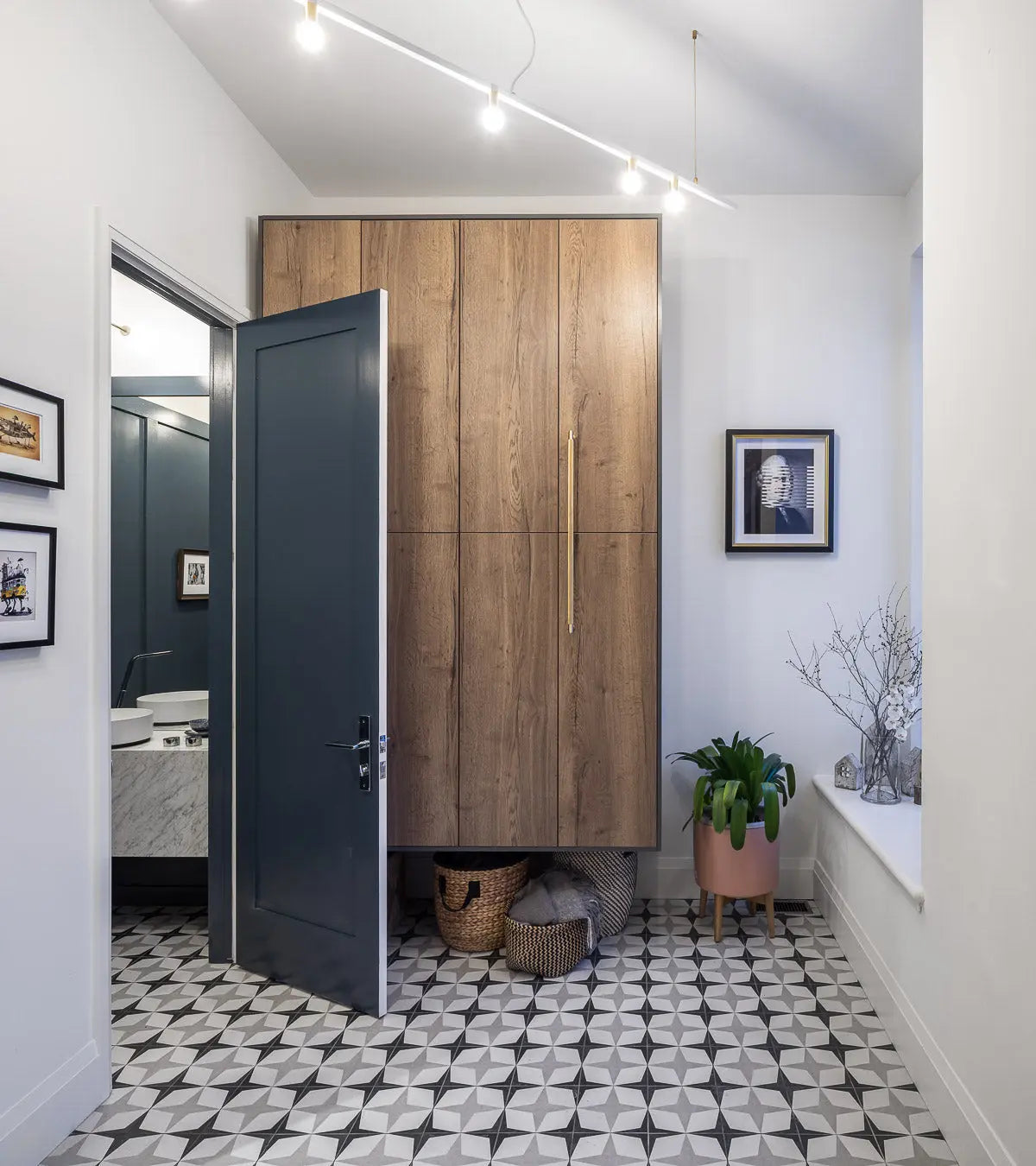
Stone carries visual weight differently depending on what surrounds it. A slab with strong veining can be the most grounding element in a kitchen or the most disruptive, depending on the tone of the cabinetry beside it, the warmth of the flooring beneath it, and the finish of the hardware mounted to it. Warm oak cabinetry has a very different conversation with white Calacatta marble than with grey-toned quartzite, even when both stones are ostensibly "neutral." A brushed brass faucet that photographs beautifully in isolation can introduce an entirely different metallic register than the polished nickel pulls already committed to two months earlier.
None of these conflicts is impossible to anticipate. But they require a different frame of thinking, one that asks not "is this right?" but "is this right in relation to everything else?"
That is the difference between selection and curation.
— — —
How projects drift and why it is rarely one decision's fault

One of the more frustrating aspects of this problem is its cumulative nature. Projects do not usually fail at a single moment of decision. They drift through a series of small misalignments, each one individually defensible, that accumulate into an outcome that feels collectively off.
A cabinet finish is chosen. It is warm, slightly matte, and works well on its own. Then a countertop is selected to complement it, but "complement" is interpreted as "match in tone," and the result is that two very similar warm surfaces occupy the same plane with no contrast between them. Then, hardware is chosen to add contrast, and because it reacts to the previous two decisions rather than to a clearly defined whole, it introduces a metallic note that the rest of the kitchen was never designed to absorb. Then a backsplash is added to balance the hardware, and by this point, the composition has become reactive; each new decision compensates for the last, rather than contributing to a clear direction.
The finished space is the sum of these compensations. It functions. It may even look quite good in certain lighting. But it does not feel settled.
This is what a curated approach is designed to prevent.
— — —
What curation actually looks like in practice

Curation begins by establishing a direction before finalizing any individual element. Not a mood board, a set of relationships. What role will each material play in the overall composition? What should anchor the space, and what should recede? Where does contrast belong, and where does continuity serve better?
These questions change how materials are evaluated. A countertop is no longer just a surface to be approved. It is either the element that grounds the kitchen or the one that allows the cabinetry to do that work, and that distinction shapes which stone is chosen, which finish is appropriate, and which edge profile is right. A faucet is not simply a fixture; it is the primary metallic presence in the bathroom, and its finish will define what all other metal elements need to reference. Wood tones are not just warm or cool; they carry grain pattern, reflectivity, and scale, each of which responds differently to the tile, stone, or painted surface beside it.
When these relationships are understood before decisions are finalized, the process becomes coherent rather than reactive. Materials can be adjusted early, when adjustments are easy. Conflicts can be identified before they become expensive. And the space can be designed as a whole rather than assembled in sequence.
This is also why a showroom visit, done properly, is something different from a shopping trip. Seeing materials side by side at real scale, under consistent light, with cabinetry samples nearby, reveals relationships that no screen can convey. The texture of a stone surface reads entirely differently at a 30-centimetre sample than it does at two and a half metres of counter. A graining pattern that appears subtle in a photograph can become the dominant visual in the room. A colour that looks warm and grounded at a paint chip can shift towards beige under the particular temperature of kitchen task lighting. The showroom is where judgment is refined. Not where choices are confirmed.
— — —
The result: spaces that feel resolved

When curation is part of the process from the beginning, the resulting spaces carry a particular quality. Transitions feel natural. Materials relate to one another without visible effort. Nothing appears to have been added as an afterthought, and nothing appears to be in conflict. The composition has an internal consistency not because everything matches, but because everything belongs.
This quality is difficult to describe but easy to recognize. It is the difference between a kitchen that works and one that continues to reward attention years after it was built, between a bathroom that functions perfectly well and one that feels like a coherent environment rather than a collection of specifications, and between a home that was completed and one that was resolved.
It is not a matter of budget, style, or complexity. It is a matter of approach. Curated spaces can be minimal or richly detailed, contemporary or traditional, restrained or expressive. What they share is not a visual language but a structural quality: the sense that every decision was made in relation to the whole, and that the whole was always the objective.
For anyone beginning a renovation or new build, this distinction is worth considering before the first material is chosen. Because the approach taken at the beginning of the process, sequential selection or relational curation, will quietly shape everything that follows.
— — —
At Astro Design Inc., material curation is part of how every project is developed, from the first conversation through the final installation. Our process is built on the understanding that the quality of a finished space depends not on the quality of individual decisions but on the quality of the relationships among them.
If you are in the early stages of a project and trying to understand how to approach material selection to produce a genuinely cohesive result, we would be glad to have that conversation.


