

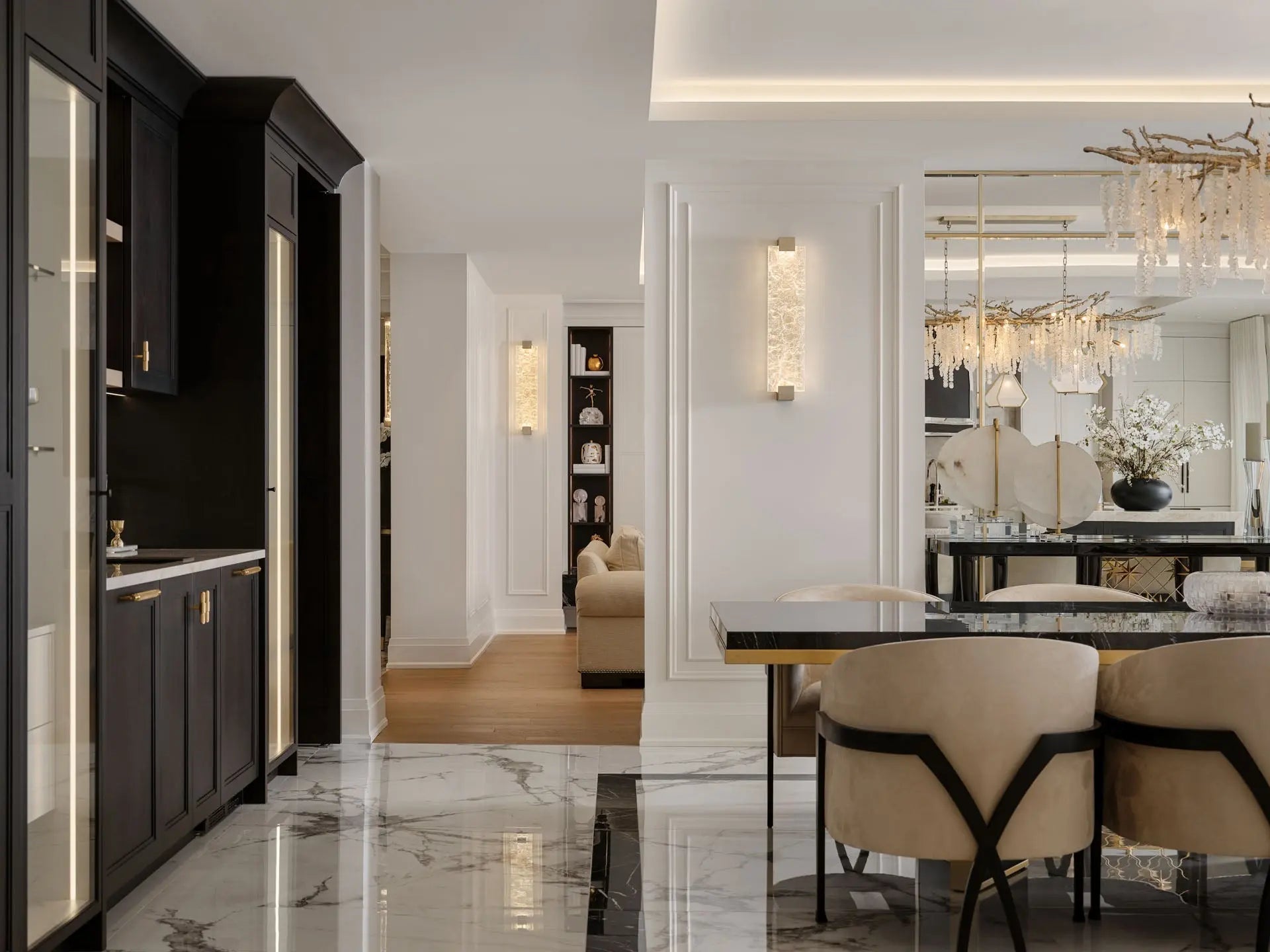
Of all the decisions made in a home renovation, lighting is the one most consistently left until the end. It is also the one that most determines how everything else feels.
You can specify the most beautiful stone countertop in Ottawa. You can select cabinetry with perfect proportions, paired with carefully chosen hardware. You can paint the walls exactly the right tone of warm white. Then the recessed lights come on, the temperature is wrong, the placement casts shadows over every surface, and the room feels institutional.
Lighting is not a finishing touch. It is the lens through which everything else is seen.
The difficulty is that lighting is largely invisible as a discipline. When a kitchen feels warm and inviting in the evening, no one says the lighting is extraordinary. They say the kitchen is beautiful. When a bathroom feels like a spa rather than a utility room, a designer made specific decisions about placement and fixture selection that have gone entirely uncredited.
This post is for homeowners who want to understand how lighting design actually works, and how to apply it room by room.
The Three Layers of Light Every Designer Uses

Professional lighting design begins with a framework that holds true in any room: distinct layers, each with a specific function, working together to produce a considered space.

Ambient is the base layer. This is the general illumination that fills a room with enough light to function, usually from recessed downlights, flush ceiling fixtures, or broadly casting pendants. The ambient layer is where most homeowners stop. On its own, it is deeply insufficient for any room where you actually want to feel something. Ambient light illuminates. It does not create atmosphere. A room with only ambient light is either at full exposure or it is dark.
Task lighting is where function is critical. This is directed illumination for specific activities such as reading, food preparation, or working at a desk. It is placed in relationship to an activity rather than to a room. In a kitchen, that means under-cabinet lights washing the countertop, not the recessed lights above that throw the counter into shadow from the person standing at it. In a bathroom, it means light flanking the mirror at face level, which eliminates the unflattering shadows that overhead fixtures produce.
Accent lighting adds depth. This is the layer that separates a considered space from a merely functional one. It draws the eye to what is worth looking at, whether artwork, architectural detail, or material texture, and allows the rest of the room to recede. Accent lighting also makes the greatest difference after dark. When the ambient lights dim and the accent layer remains, a room reveals itself in an entirely different way. A house that looks beautiful at noon and feels flat at 8 p.m. almost always lacks a considered accent layer.
A Room-by-Room Strategy

The Kitchen
The hardest room to light well is the one that must perform at the highest level for several activities at once. The most common failure is relying entirely on a grid of recessed downlights, which produce even, flat illumination with no warmth and no hierarchy. They make a kitchen look like an office. A properly layered plan puts recessed ambient lights on a dimmer, adds under-cabinet task lighting over every prep surface, hangs pendants over the island for both function and visual interest, and includes at least one accent layer, such as interior cabinet lighting or toe-kick glow, that transforms the room after dark.

The Bathroom
Where the conflict between function and atmosphere is sharpest. You need an excellent task light at the mirror for grooming. You also want the room to feel like a retreat. The solution is not a single compromise fixture overhead. It is two systems: flanking lights at face height for task function, and a separate ambient or accent layer for atmosphere. Put them on separate circuits and separate dimmers, so the bathroom can be bright and functional in the morning and calm in the evening.
The Dining Room

Its pendant is one of the most consequential decisions in the home, and one most frequently hung at the wrong height. As a general rule, the bottom of the fixture should sit roughly 30 to 34 inches above the table surface. That places the light where it illuminates the table and the faces around it while keeping the fixture within the visual frame of seated guests. Too high and it reads as a ceiling fixture rather than a dining object. Too low and it interrupts sightlines across the table.
The Living Room

Most consistently benefits from layered lighting, yet it is where homeowners most often rely on a single ceiling fixture. A well-lit living room uses multiple circuits: ambient lighting on dimmers, table lamps that create pools of warm light at seated level, and directional accent lighting for artwork or architectural features. The goal is flexibility. A room that can move from bright and energetic to calm and atmospheric without changing a single bulb feels luxurious in the truest sense.
Colour Temperature: Warm vs Cool

The Kelvin rating of a light source is one of the most misunderstood specifications in residential lighting and one of the most impactful factors in how a room feels.
Kelvin measures the colour temperature of light. Lower numbers, around 2700K to 3000K, produce warm, amber-toned light, the quality associated with candlelight and relaxed, residential rooms. Higher numbers, from 3500K upward, produce cooler, bluer light closer to that of an office or daylight.
For residential interiors, 2700K is the standard for living spaces, bedrooms, and dining rooms. It sits at the warmest end of the spectrum and reads as decidedly residential. A slightly crisper 3000K suits kitchens and bathrooms, where better colour rendering helps with food preparation and grooming.

One of the most common errors is mixing temperatures within a room or across
adjacent spaces. A 2700K pendant over a dining table beside 4000K recessed lights in an open-plan kitchen will fight visually, creating discomfort the homeowner often cannot name. Temperature consistency is the difference between a home that feels cohesive and one that feels fractured. When in doubt, go warmer. Cooler temperatures make a space feel commercial. Warmer temperatures make it feel like home.
A quick reference: use 2700K for living areas, dining, and bedrooms; 2700K to 3000K for kitchens and bathrooms; 3000K to 3500K for home offices and task areas; and match accent sources to the room's ambient tone.
What to Look for in a Showroom Collection
When evaluating fixtures, the quality indicators that matter most are not always obvious. The weight of a fixture speaks to material quality. The consistency of a finish reveals the manufacturing standard. The shade material and its translucency determine how the light itself reads once switched on. A fixture that looks beautiful unlit may disappoint when illuminated if the shade diffuses unevenly or the bulb creates hot spots.
This is why fixtures are best evaluated in an interior environment rather than a catalogue image. Ask how the light quality changes as it dims, whether the finish coordinates with the hardware already chosen for the room, and whether the scale suits the space against a real reference measurement. Astro Design Inc.'s showroom carries a curated selection of lighting meant to be assessed in exactly this way, alongside the other materials it will share a room with.
The Room You Have Always Wanted Was Always There
Lighting determines whether a home fulfils its potential. It is what separates a beautiful kitchen that feels like a photograph from one that feels like a place to live.
The encouraging part is that well-made lighting decisions are not particularly expensive relative to their impact. Understanding the layers, specifying the right temperatures, and designing for multiple circuits is available to any renovation at any budget. What it requires is intentionality and making those decisions before the electrician's rough-in, rather than after.
If you are planning a renovation or simply want a room to feel the way you always pictured, our designers can help you create a lighting plan that works.
Book a complementary consultation with us, or visit our showroom at 1818 A Woodward Drive in Ottawa to see considered lighting in an interior context.


